
390 m² Government Office Transformation, 13 Rooms Delivered in 45 Days
10/9/20232 min read
Regional Public Service Office — 390 m², 13 Rooms, Completed in 45 Days
A 390 m² public service office underwent a comprehensive upgrade to move beyond the rigid image of conventional government interiors. The project covers 13 functional rooms, delivered within 45 days through structured coordination and controlled execution.
The objective was clear: create a modern, welcoming environment without losing institutional authority.
Design Concept: Civic Hospitality
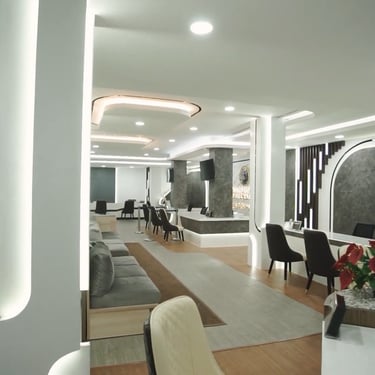
The space was designed to feel structured yet approachable. Circulation is clear, lighting is layered, and materials are durable.
Key architectural strategies include:
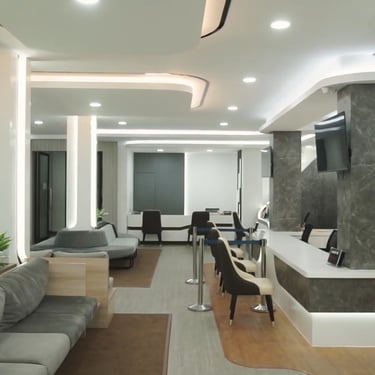
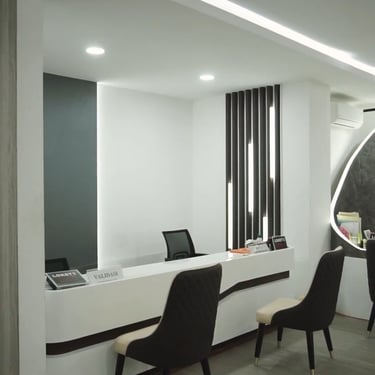
Integrated linear lighting across walls, columns, and ceilings serving as visual guidance and rhythmic accents.
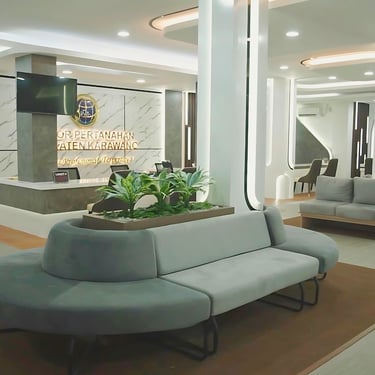
A warm neutral palette combining white, gray, natural stone textures, and wood finishes for balanced professionalism.
Curved architectural details on openings and ceiling edges to soften geometry and improve acoustic comfort.
The result is a public office that feels organized and human-centered.
Spatial Layout and Flow
The 13-room configuration supports operational clarity:
Lobby and Integrated Service Area with a long front desk and guided queue system.
Four Customer Service Counters designed for ergonomic interaction and partial privacy.
Main Waiting Area featuring modular seating and a central green element as a visual anchor.
Two Consultation Rooms with light acoustic separation.
Head Office Room with refined finishes and controlled detailing.
Open Secretariat Area with concealed storage solutions.
Compact Archive Room positioned near service zones.
Small Meeting Room for internal coordination.
Pantry Area supporting staff comfort.
Server and Utility Room with organized routing systems.
Separate Restrooms for guests and staff with durable, easy-maintenance finishes.
Circulation follows a direct sequence: entrance to queue, queue to counter, counter to consultation. Guest and back-office traffic remain separated, reducing congestion during peak hours.
Lighting as Spatial Language
Lighting plays both functional and architectural roles.
Layered ceiling systems with linear coves provide uniform illumination without glare.
Column-integrated lighting acts as subtle landmarks.
Backlit signage improves visibility and orientation.
Neutral-warm color temperature ensures visual comfort and accurate document handling.
Material Strategy
Core columns and reception backdrops use textured stone finishes to reinforce institutional presence.
Flooring combines durable vinyl and wood accents for maintenance efficiency.
Acoustic panels in selected areas reduce noise from service interactions.
Built-in furniture features rounded edges for safety and ease of cleaning.
Technology and Comfort
Queue displays and digital signage are integrated discreetly within architectural elements.
HVAC systems are calibrated to maintain comfort in high-traffic zones.
Accessibility paths, inclusive counter heights, and tactile flooring cues ensure universal usability.
Execution Within 45 Days
Speed was achieved through preparation and sequencing.
Pre-fabricated wall panels, counter modules, and lighting components reduced on-site installation time.
Day-night shift coordination maintained momentum.
Zone-based quality control ensured each section met standards before progressing.
Impact
The upgraded environment improves perceived efficiency and reduces user stress through clarity and brightness.
The completed workspace reflects a modern public service identity—structured, professional, and approachable—setting a higher benchmark for institutional interiors.
Operations Office :
Jl. Swadaya No.32,
Pd. Ranggon, Cipayung, Jakarta Timur
0823 2207 2021
marketing@uhsindonesia.id
© 2025 UHS Indonesia


Head Office :
Gedung Menara 165 Lantai 4,
Jl. TB Simatupang Kav 1, Jakarta